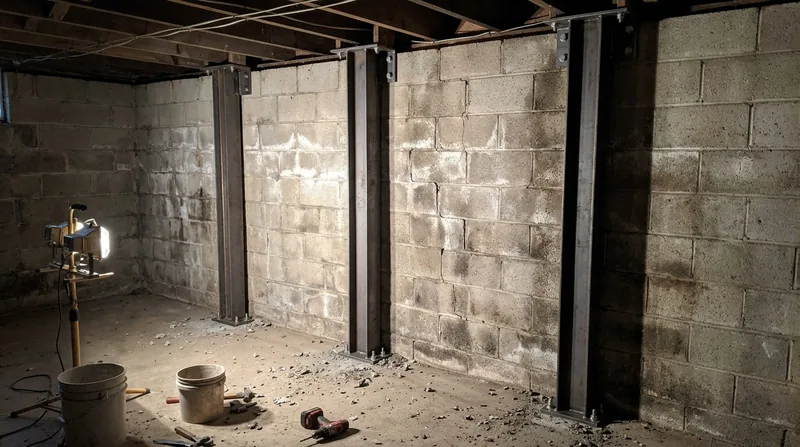




Why Bowing Walls Are a Clarksville Problem, Not Just an Old-House Problem
If you own a home in Clarksville, you already know the ground here moves. The city sits on the Pennyroyal Plateau where the Red River meets the Cumberland, and that means red clay over cavernous limestone, bluffs that push runoff toward the river, and low ground that took on water in May 2010. When that clay gets saturated, it does not drain. It swells, it pushes, and it leans on your basement wall until the wall starts to bow inward. Bowing Wall Repair in Clarksville is the work of stopping that movement and putting the wall back under control.
We see it most in three building types. Downtown and the bluffs above the Cumberland hold 1850s to 1910s Italianate, Queen Anne, and Greek Revival homes on old brick and limestone foundations that were never built for today's water loads. The Madison Street area and New Providence hold 1920s to 1950s bungalows and Tudors with full and partial basements. Hilldale and Woodlawn hold 1960s to 1980s brick ranches and split-levels on hilly lots, and that is where saturated red clay pushes hardest on older block walls. If you want the full picture of how water gets in, start with our basement waterproofing page, then come back here for the structural side.
Here is the honest part. A bowing wall is not a crack you seal and forget. It is a symptom of hydrostatic pressure that has been building for years, and it needs a structural answer matched to how far the wall has moved and what soil is pushing on it.
Why Saturated Red Clay Pushes Clarksville Basement Walls In
Montgomery County clay holds water like a sponge and releases it slowly. After a heavy spring rain or a summer thunderstorm, the soil behind your wall is heavier than it was designed to be, and the water table rises against the footing. The wall takes that load across its whole face, not at one point, which is why you see a horizontal crack at mid-height and a belly in the middle of the wall rather than a single vertical split.
The failure modes we find on Clarksville walls are consistent:
- Horizontal cracking at mid-wall, which is the classic sign that soil pressure has exceeded what the block can carry.
- Inward bowing of the wall face, measured with a string line or a level to see how far it has moved.
- Stair-step cracking through mortar joints on older brick and block walls on the bluffs.
- Efflorescence and white mineral staining, which tells you water has been moving through the wall for a long time.
- Sticking windows and doors on the lower level, because the wall has moved the frame with it.
Any one of those is a reason to get the wall looked at before the next wet season adds more load. Two or more together means the wall is actively moving.
Key info: On a 1960s split-level in Hilldale, we measured a block wall that had bowed 1.5 inches over 20 feet, with a horizontal crack running the full length at mid-height. The cause was not a failed wall, it was a downspout that dumped at the same corner for decades. The wall got carbon fiber straps, and the discharge got extended. Both had to happen.
If you want to understand how the local building department views structural foundation work, the Montgomery County government site is the place to verify permit requirements, because thresholds vary and the rules are enforced locally.
How We Repair a Bowing Wall in Clarksville, Step by Step
We do not pick a method before we know how far the wall has moved and what is pushing it. The first visit is a measurement and a diagnosis, not a sales pitch. We check the wall with a level and a string line, map the cracks, look at the grading and downspouts on the outside, and check whether the footing drain is still moving water or has silted shut.
- We measure the deflection and record the crack pattern so we have a baseline to compare against later.
- We identify the pressure source: saturated clay, a blocked footing drain, a downspout dumping at the corner, or a rising water table.
- We match the repair to the severity, from carbon fiber straps on a wall that has moved less than 2 inches to steel I-beams or wall anchors on a wall that has gone further.
- We relieve the water pressure so the repair is not fighting the same load that caused the problem, usually with an interior perimeter drain and a sump basin.
- We verify the repair with a follow-up measurement and give you a transferable warranty on the work.
The order matters. Strapping a wall while the clay behind it stays saturated is a temporary fix, and we will tell you that plainly.
Key info: A 1920s bungalow near Madison Street had a bowing wall and a wet floor after every storm. The wall got steel I-beams, and the water got handled with an interior drain tile system tied to a new sump basin. Repairing one without the other would have put us back in the same basement in two years.
Matching the Repair Method to the Wall and the Soil
There is no single answer for every bowing wall, and any contractor who quotes one method before measuring is guessing. The table below shows how we match the approach to the movement and the soil condition we find on Clarksville lots.
| Approach | Description | Best for |
|---|---|---|
| Carbon fiber straps | High-strength straps bonded vertically to the wall face and anchored at the floor and sill. | Block walls that have bowed less than 2 inches with no active water at the crack. |
| Steel I-beams | Vertical steel beams set against the wall and tied into the floor and joist system. | Walls with heavier movement or where the block has begun to crack through the face. |
| Wall anchors | Anchors set in the soil outside pull the wall back through a rod tied to an interior plate. | Walls that have moved more than 2 inches and can be pulled back toward plumb. |
| Pressure relief plus repair | Interior perimeter drain, sump basin, and discharge line installed alongside the structural fix. | Walls where saturated clay or a failed footing drain is the root cause. |
We combine methods when the wall and the water both call for it, and we say so when a simpler repair will hold.
Bowing Wall Repair Cost in Clarksville: What to Expect
Pricing for bowing wall repair starts at From $600 for the smallest scopes, such as a limited strap installation on a wall with minor movement and no water problem. Most real repairs land well above that once the wall has bowed an inch or more, because the work involves engineering the load path and often relieving the water pressure behind the wall at the same time.
What moves the number:
- The linear footage of wall that has moved, since straps and beams are priced by the foot.
- The severity of deflection, because a wall past 2 inches usually needs anchors or beams rather than straps alone.
- Whether the footing drain is failed and has to be replaced as part of the job.
- Access to the wall, since a finished basement adds protection work before we start.
- Whether the repair is structural only or paired with an interior drain tile system and sump.
Get two or three estimates and compare what each one actually includes, not just the bottom line. A quote that straps the wall without addressing the saturated clay is cheaper for a reason. Our full pricing overview lays out how the numbers break down.
Bowing Wall Repair Near Me: How to Vet a Clarksville Contractor
Searching for bowing wall repair near me in Clarksville returns a lot of names, and not all of them do structural work. A dedicated basement waterproofing specialist is not the same as a general foundation-repair firm or a plumber, and the difference shows up in how they diagnose the wall and what they propose.
Ask these questions before you sign anything:
- Are you licensed and insured for structural work in Tennessee, and can I see the certificate?
- Will you measure the deflection and show me the number, or just eyeball it?
- Do you handle the permit if the local building department requires one for structural foundation repair?
- Can you give me references from Clarksville, Sango, or Woodlawn homes with the same wall type?
- What warranty comes with the work, and is it transferable?
We are a Basement Health Association member, we measure every wall, and we tell you when a simpler repair is enough. Reach out through our contact page to set up a free basement inspection, and we will give you the numbers in writing.
Bowing Wall Repair in Clarksville: Pricing Guide
| Service | Price | Details |
|---|---|---|
| Carbon fiber strap installation | Starting at $600 | Covers limited strap work on minor wall movement, priced per strap and linear footage. |
| Steel I-beam stabilization | Starting at $1,800 | Includes beam placement and floor tie-in, with cost rising by wall length and access. |
| Wall anchor system | Starting at $3,200 | Exterior anchors pull the wall back toward plumb, priced by anchor count and soil condition. |
| Repair plus pressure relief | On estimate | Structural fix paired with interior drain tile and sump, scoped after on-site measurement. |
| Travel | Included | In Clarksville and surrounding areas, no separate call-out or mileage fee. |
| Estimate | Free | Response within 24h at (931) 389-5665, no obligation to book. |
Indicative pricing, the exact cost depends on square footage, finish, and site access. Free personalized estimate within 24h at (931) 389-5665.


