Why Clarksville's Ground Is Different From What You See
When you look out over a yard in Clarksville, you see grass, a driveway, maybe a fence line. What sits under that topsoil is a different story entirely. Much of Montgomery County rests on karst limestone, a rock that dissolves slowly over time when water moves through it. That dissolving process creates voids, channels, and caves underground, and those features change how water behaves beneath your home. Instead of running off the way it might on solid bedrock, rainwater can disappear into the ground quickly and reappear somewhere else, sometimes directly against a foundation wall.
On top of that limestone sits a layer of red clay, the heavy, sticky soil that Middle Tennessee is known for. Red clay does not drain well. When it gets wet it expands, and when it dries out it shrinks and cracks. That constant swell and shrink cycle puts pressure on foundation walls and can pull soil away from the house, creating gaps where water collects. Homeowners in Sango and St. Bethlehem see this play out in different ways depending on how their lot was graded, but the underlying geology is the same. Understanding this two-layer system (porous limestone below, expansive clay above) is the first step toward understanding why basements here leak.
Karst Limestone and the Clarksville Sinkhole Connection
A Clarksville sinkhole basement problem is not something most homeowners think about until they notice a depression in the yard or a crack that was not there last year. Karst landscapes are prone to sinkholes because the limestone underneath is being slowly eaten away by groundwater. When the clay soil above loses support, it collapses downward, sometimes gradually and sometimes suddenly. A sinkhole near a foundation can redirect surface water straight toward the house, and it can also undermine the footings that hold the structure up. Even a small sinkhole a few feet from a basement wall is worth taking seriously.
The tricky part is that karst features are not always visible. Water can travel through underground channels and emerge against a foundation wall on the opposite side of the yard from where the rain fell. That is why a karst limestone foundation issue often looks like a mystery leak: the wet spot inside the basement has no obvious relationship to the downspout or the slope outside. If you have noticed water appearing in one consistent area after heavy rain, or if the ground around your home has settled unevenly, it is worth having someone look at both the soil and the drainage. A proper assessment considers the limestone below as much as the clay above.
Red Clay, Soil Movement, and Montgomery County Basement Leaks
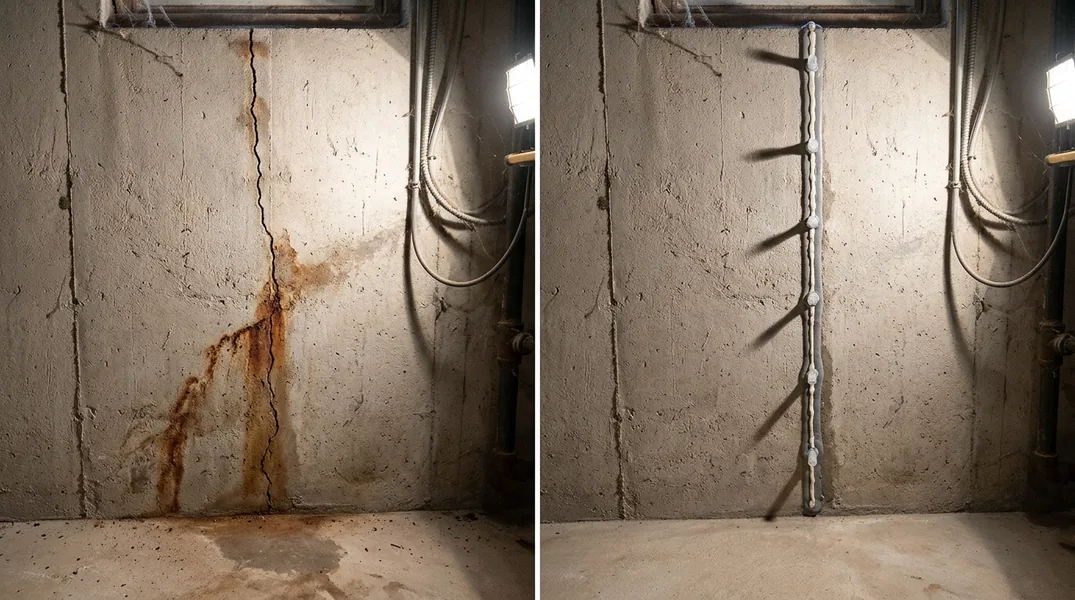
Red clay is the other half of the equation, and for many homeowners it is the more immediate culprit. This soil holds water like a sponge and expands as it absorbs it. Against a foundation wall, that expansion creates hydrostatic pressure, which is a polite way of saying the wet clay is pushing hard against your basement. Over time, that pressure finds weak points: hairline cracks in poured concrete, mortar joints in block walls, and the seam where the wall meets the floor. Once water gets through, it usually keeps getting through. Montgomery County basement leaks are frequently traced back to this pressure cycle rather than to a single obvious defect.
Soil movement works in the other direction too. During dry stretches, red clay shrinks and pulls away from the foundation, leaving a gap that acts like a funnel for the next rain. That is why some basements stay dry for months and then leak heavily after a storm. The fix is not simply patching the crack you can see. Foundation Waterproofing addresses the water before it reaches the wall, and it accounts for how the soil around your home behaves through wet and dry seasons. Homeowners in Woodlawn and other parts of the county deal with the same clay, and the solutions tend to follow the same logic: manage the water, relieve the pressure, and protect the wall.
Basement Waterproofing Near Me: When to Call a Professional
Some basement moisture is a minor nuisance, but some of it is a sign that the ground around your home is working against you. If you see efflorescence (the white powdery stain on concrete walls), standing water after storms, musty odors that do not go away, or cracks that seem to be widening, those are signals worth acting on. The same is true if you have noticed a sinkhole or depression in the yard, or if doors and windows have started sticking in ways they did not before. In a karst and red clay environment, small warning signs can point to larger movement below the surface, and catching them early usually means a simpler, less expensive repair.
When you search for basement waterproofing near me, the goal is to find someone who understands local soil and geology, not just someone who will smear sealant on a wall. A good contractor will look at the grading, the downspouts, the soil type, and the signs of movement before recommending a solution. Depending on what they find, the answer might involve an Interior Drain Tile System to capture water that reaches the footing, or Exterior Basement Waterproofing to keep water from building up against the wall in the first place. Sometimes both approaches make sense together. The right answer depends on your specific lot, and a professional assessment is how you get there.
What a Realistic Plan Looks Like for Clarksville Homeowners
Every home is different, but a sensible plan for a red clay foundation in this area usually starts with water management at the surface. That means gutters that actually carry water away from the house, downspout extensions that discharge several feet out, and grading that slopes away from the foundation rather than toward it. These steps are inexpensive and they reduce the volume of water that ever reaches the basement. From there, a contractor can evaluate whether the foundation needs a drainage system, a vapor barrier, crack injection, or some combination of methods. The goal is a dry basement and a foundation that is not being pushed around by expanding clay.
It also helps to know what you are likely to spend before you start calling around. pricing varies with the size of the basement, the extent of the water problem, and the method chosen, so a reputable company will want to see the space before giving you a number. You can request a free estimate from Clarksville Waterproofing by calling (931) 389-5665. A technician will look at the interior signs, the exterior drainage, and the soil conditions, then explain what is happening and what it would take to fix it. That conversation is the most useful thing you can do if you are unsure whether your basement issue is cosmetic or structural.
Looking for a professional basement waterproofing contractor in Clarksville? Clarksville Waterproofing responds fast for all your basement waterproofing needs.
Get a Free QuoteOur services: Basement Waterproofing · Interior Drain Tile System · Exterior Basement Waterproofing